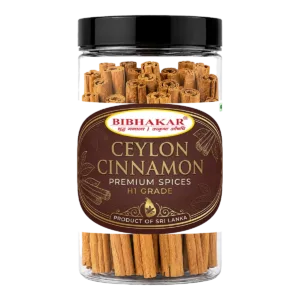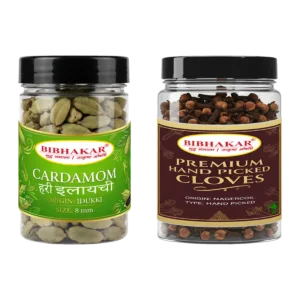
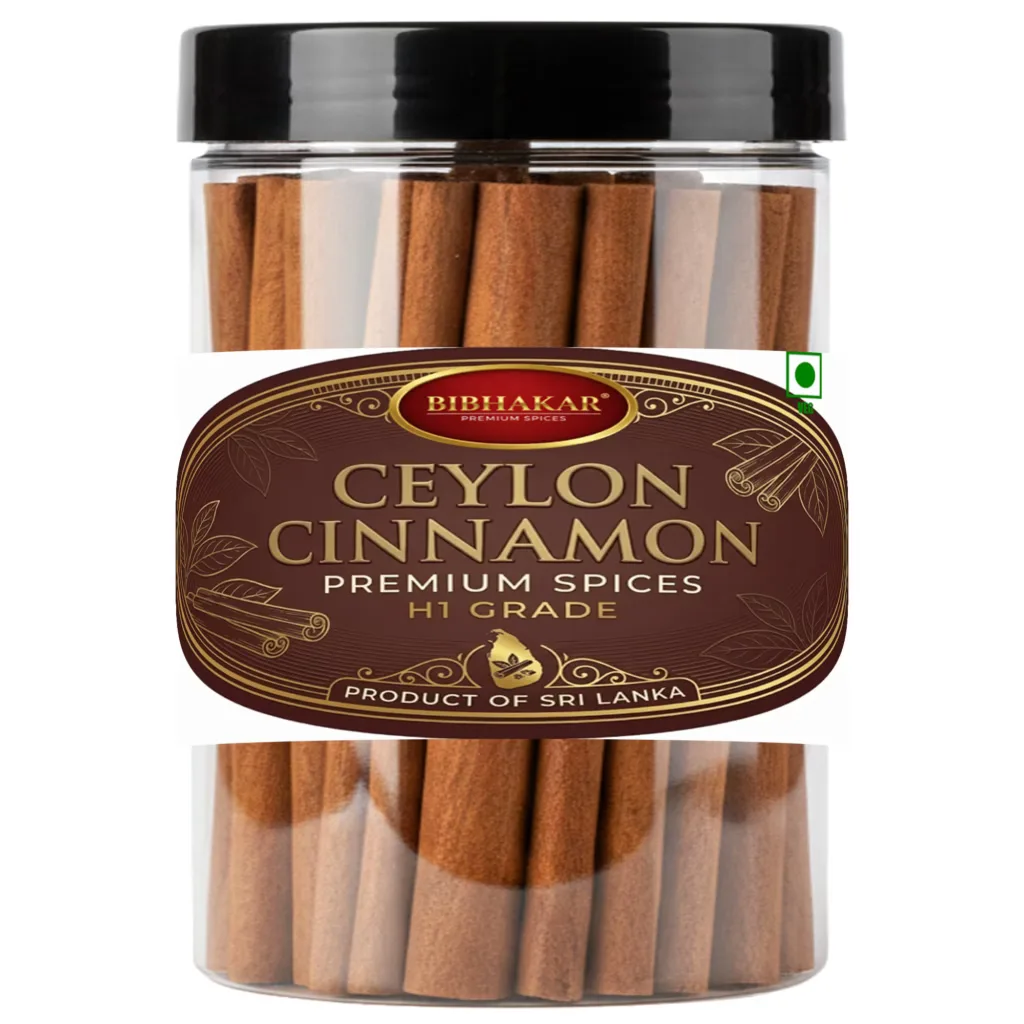
True Ceylon cinnamon is the bark of Cinnamomum verum, grown mainly in Sri Lanka. You can identify it by its many paper-thin layers rolled into a soft quill, its pale tan colour and its mild, sweet taste. Cassia, the more common dalchini in India, is one thick, hard layer of darker red-brown bark.
Key facts: Bibhakar Spices Ceylon cinnamon
- Botanical name: Cinnamomum verum (true cinnamon)
- Origin: Sri Lanka
- Grade: H1 quills, 16 to 23 mm across
- Form: rolled quills, packed whole in clear jars
- Jar sizes: 50 g (₹229), 100 g (₹449), 200 g (₹879)
Bibhakar Spices sells Sri Lankan Ceylon cinnamon, H1 grade quills, in 50 g, 100 g and 200 g jars.
For a short side-by-side answer to “Ceylon vs cassia”, see the comparison on The Bibhakar Standard. This guide focuses on how to check a stick in your hand.
What does true Ceylon cinnamon look like?
Ceylon cinnamon is made by peeling the thin inner bark from young shoots and rolling the strips inside each other while they dry. The result is a quill that looks like a cigar of many layers.
Look at the cut end of a stick:
- Ceylon: many thin layers, packed together like rolled paper, with a filled centre.
- Cassia: one or two thick layers curled into a hollow tube or a single scroll.
The outside of a Ceylon quill is smooth and light tan to pale brown. Cassia is usually darker and rougher, often with a reddish tone.
Five checks to tell Ceylon from cassia at home
- Count the layers. Many fine layers point to Ceylon. One thick layer points to cassia.
- Press the stick. Ceylon crumbles or splinters between your fingers. Cassia is hard and woody; you need a grinder or pestle to break it.
- Check the colour. Ceylon is pale tan. Cassia is dark red-brown.
- Measure the thickness of the bark wall. Ceylon bark layers are paper-thin. Cassia bark is visibly thick and rigid.
- Taste a small piece. Ceylon is mild, sweet and slightly citrusy. Cassia is stronger, hotter and more biting.
If a pack is labelled “cinnamon” or “dalchini” without a botanical name, and the sticks pass the cassia checks, it is cassia. That is not a fault, as cassia is a useful spice in its own right, but you should know what you are paying for.
What does the H1 grade mean?
Sri Lankan quills are graded by their diameter into four groups: Alba (the thinnest), Continental, Mexican and Hamburg (the thickest). Each group has sub-grades, and H1 is a Hamburg sub-grade, a thicker quill often sold for everyday cooking. Published sources give slightly different diameter ranges for H1; our H1 quills measure 16 to 23 mm across.
The grade tells you about thickness, not whether the cinnamon is true. A Hamburg grade quill is still Cinnamomum verum if it comes from the true cinnamon tree.
Why does coumarin come up when people compare cinnamon?
Coumarin is a natural flavouring substance found in cinnamon bark. Germany’s Federal Institute for Risk Assessment (BfR) sets a tolerable daily intake of 0.1 mg of coumarin per kg of body weight. The BfR notes that cassia can contain high levels, and that an adult weighing 60 kg could reach that amount with about 2 g of cassia a day.
The same BfR guidance says Ceylon cinnamon contains only low levels of coumarin. For people who use cinnamon daily in larger amounts, such as in porridge, baking or cinnamon water, this is one practical reason to choose Ceylon. For a stick in a biryani once a week, the difference matters far less.
This is general food-safety information, not medical advice.
When should you use Ceylon and when cassia?
Both are sold as dalchini, and both have a place:
- Ceylon suits chai, kheer, cakes, fruit and light curries, where its gentle sweetness shows.
- Cassia stands up to long cooking in biryani, pulao, meat curries and garam masala.
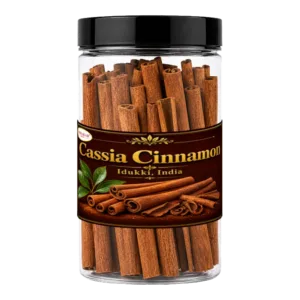
We sell both and name each one on the jar. Our Ceylon cinnamon H1 quills are Sri Lankan Cinnamomum verum. Our cassia cinnamon (dalchini) is H1 sticks of Cinnamomum cassia from Idukki, priced from ₹109 for 50 g.
How should you store cinnamon sticks?
Keep sticks whole in a closed jar away from the stove and sunlight. Whole quills hold their aroma far longer than powder. Grind or grate only what you need. Ceylon is soft enough to break by hand or grate on a fine grater, which makes small amounts easy.
To read about how Ceylon cinnamon is grown and dried in Sri Lanka, see our earlier post on the journey of Ceylon cinnamon.
Frequently asked questions
How can I tell if cinnamon is true Ceylon cinnamon?
Look at the end of the stick. True Ceylon cinnamon shows many thin layers rolled together like a cigar, is pale tan and crumbles when pressed. Cassia shows one thick, hard layer, is darker red-brown and needs a grinder to break. A botanical name of Cinnamomum verum on the pack also confirms it.
Is the dalchini sold in Indian markets Ceylon or cassia?
Most dalchini sold loose in Indian markets is cassia, which is thicker, darker and stronger. Ceylon cinnamon is usually sold separately and labelled as Ceylon or Sri Lankan cinnamon. If the sticks are hard, single-layered and red-brown, they are almost certainly cassia, whatever the label says.
What does H1 mean on Ceylon cinnamon?
H1 is a Hamburg grade, one of the Sri Lankan quill grades based on diameter. Hamburg grades are thicker quills commonly sold for cooking. The grade describes size, not purity, so an H1 quill is still true cinnamon if it comes from Cinnamomum verum. Ours measure 16 to 23 mm across.
Does Ceylon cinnamon have less coumarin than cassia?
Yes. Germany’s BfR states that Ceylon cinnamon contains only low levels of coumarin, while cassia can contain high levels. The BfR’s tolerable daily intake is 0.1 mg per kg of body weight, which a 60 kg adult could reach with about 2 g of cassia a day.
Sources
- Cinnamon (Practical Action technical brief), quill grades Alba, Continental, Mexican and Hamburg
- FAQ on coumarin in cinnamon and other foods, Federal Institute for Risk Assessment (BfR), Germany
Filed under Spice Guides · All articles · Shop all spices