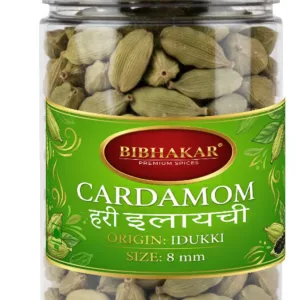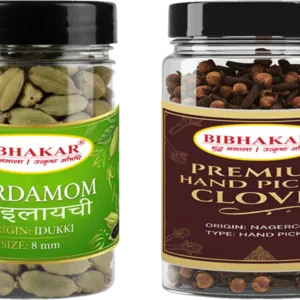
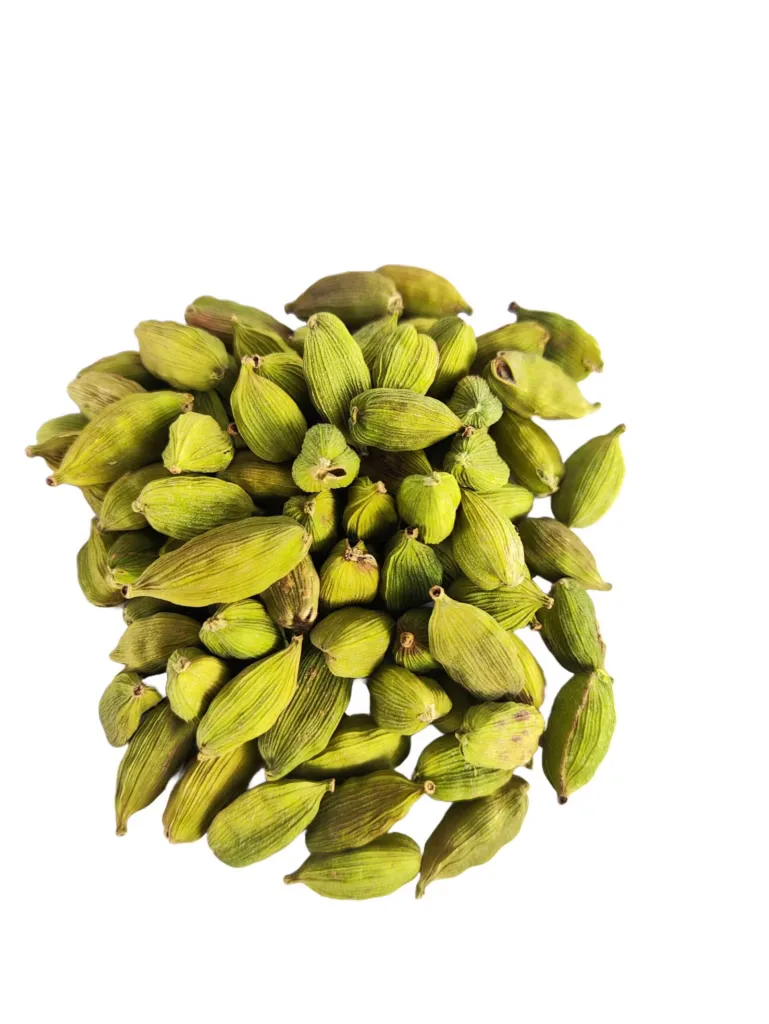
The elaichi price you pay is set mainly by pod size, colour, moisture, cleaning and pack size. Bigger, greener, drier pods cost more because they are a small share of each harvest. Small jars cost more per gram than large ones. Green cardamom (choti elaichi) is the dried fruit of Elettaria cardamomum, grown mostly in Kerala and Tamil Nadu.
Key facts: Bibhakar Spices green cardamom
- Origin: Idukki district, Kerala
- Grade: 8 mm and above (bold), moisture 10% or less
- Form: whole dried pods, packed in clear jars
- Jar sizes: 10 g, 25 g, 50 g, 100 g, 250 g and 500 g
- Price per 100 g: ₹1,090 (10 g jar) down to ₹810 (500 g jar)
Bibhakar Spices sells Idukki green cardamom (elaichi), 8 mm grade, in 10 g to 500 g jars priced ₹109 to ₹4,049.
What decides the price of elaichi?
Cardamom is not one product with one price. Traders sort it into grades, and each grade sells at a different rate. Five things move the price most:
- Pod size. Pods are sieved by diameter. Larger pods are fewer in each harvest and fetch more. A reference text on cardamom grading lists the export grade AGEB (Alleppey Green Extra Bold) as 7 mm and above, AGB (Bold) as 6 mm and above and AGS (Superior) as 5 mm and above.
- Litre weight. A litre of well-filled pods weighs more than a litre of light, hollow ones. The same grading text gives a minimum of 435 g per litre for AGEB and 385 g for AGS.
- Colour. An even, deep green shows careful drying. Pale, yellow or patchy pods sell lower.
- Moisture. Wet pods weigh more and lose aroma faster in storage. Drier pods cost more per kg because you are paying for spice, not water.
- Cleaning. Split pods, empty husks, stalks and dust are picked out by hand before packing. Each round of sorting loses weight and adds labour.
Season matters too. Wholesale cardamom is sold through e-auctions run with the Spices Board of India at Puttady (Idukki) and Bodinayakanur (Theni), and the Board publishes weekly market price sheets. Rates move with the size of the crop and with demand before festivals.
How much does elaichi cost per 100 g on our site?
The table below uses our live jar prices on 8 November 2026. Prices include GST.
| Jar size | Price | Price per 100 g |
|---|---|---|
| 10 g | ₹109 | ₹1,090 |
| 25 g | ₹249 | ₹996 |
| 50 g | ₹479 | ₹958 |
| 100 g | ₹929 | ₹929 |
| 250 g | ₹2,059 | ₹824 |
| 500 g | ₹4,049 | ₹810 |
The 500 g jar works out to ₹8,098 per kg. That is the figure to compare when you see “elaichi price 1 kg” quoted elsewhere, as long as the grade and moisture are the same.
Why does a small jar cost more per gram?
Every jar carries the same fixed costs: the jar, the cap, the label, filling and checking. On a 10 g jar those costs are spread over very little spice, so the price per 100 g is higher. On a 500 g jar they almost disappear.
A simple rule for home kitchens:
- Buy 10 g or 25 g if you use elaichi only for chai on weekends or want to try a new source.
- Buy 50 g or 100 g if you make chai daily or cook biryani and sweets often.
- Buy 250 g or 500 g for large families, festive cooking or a shop kitchen, and keep the jar closed between uses.
Free shipping applies on orders over ₹799, so a larger jar can also save the ₹90 delivery charge.
How do you compare elaichi prices fairly?
A cheaper price per kg is only cheaper if the spice is the same. Before you compare, check these on the label or product page:
- Size grade in mm, not just the word “bold” or “premium”.
- Moisture if it is stated.
- Origin, ideally the district, not just “India”.
- Whole pods or seeds. Loose cardamom seeds lose aroma faster than seeds kept inside the pod.
- Price per 100 g, worked out yourself if the seller does not show it.
Then open a pod. Good cardamom has sticky, dark seeds and a strong, sweet smell. Pale grey or brown seeds and a weak smell point to old or poorly stored stock.
Our grading and checking steps are listed on The Bibhakar Standard, and the full size range is on the green cardamom (elaichi) product page.
Is green cardamom priced like black cardamom?
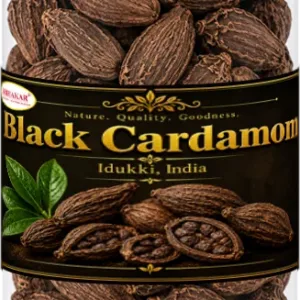
No. Black cardamom (badi elaichi) is a different plant, Amomum subulatum, with large, smoky pods used whole in dals and biryani. It is graded and priced separately. On our site, black cardamom (badi elaichi) costs ₹519 for 100 g, against ₹929 for 100 g of 8 mm green cardamom. For how the two taste and where each one goes, see our earlier post on green cardamom and black cardamom.
Where to buy whole elaichi online
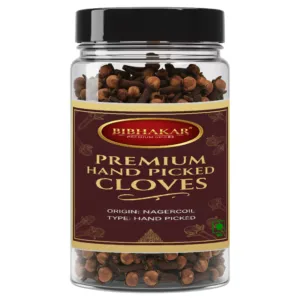
If you want one jar for daily chai, start with the 50 g or 100 g size. If you also want cloves for garam masala and biryani, the Kitchen Essentials Box pairs green cardamom with whole cloves in two clear jars.
Frequently asked questions
What is the elaichi price per kg?
On Bibhakar Spices, Idukki green cardamom of 8 mm grade costs ₹4,049 for a 500 g jar, which equals ₹8,098 per kg. Smaller jars cost more per gram. Market rates for other grades vary with pod size, colour, moisture and the season, so compare the same grade before comparing prices.
What does 8 mm mean on a cardamom pack?
It means the pods were sieved so that only pods about 8 mm across or larger remain. Larger pods are a smaller share of each harvest, so they cost more. A grading reference lists the AGEB export grade as 7 mm and above, so 8 mm sits at the top of the range.
Why is elaichi so expensive compared with other spices?
Cardamom is picked by hand over several rounds, dried slowly to keep its green colour, and then sorted by size. Only part of each harvest reaches the bold grades. Prices also move with the crop size each season, which is tracked through the Spices Board e-auctions at Puttady and Bodinayakanur.
Is it cheaper to buy cardamom seeds instead of pods?
Loose seeds can look cheaper, but they lose their aroma faster once taken out of the pod. Whole pods protect the seeds until you crush them. For chai, biryani and sweets, buying whole pods and opening them as needed usually gives more flavour for the money spent.